





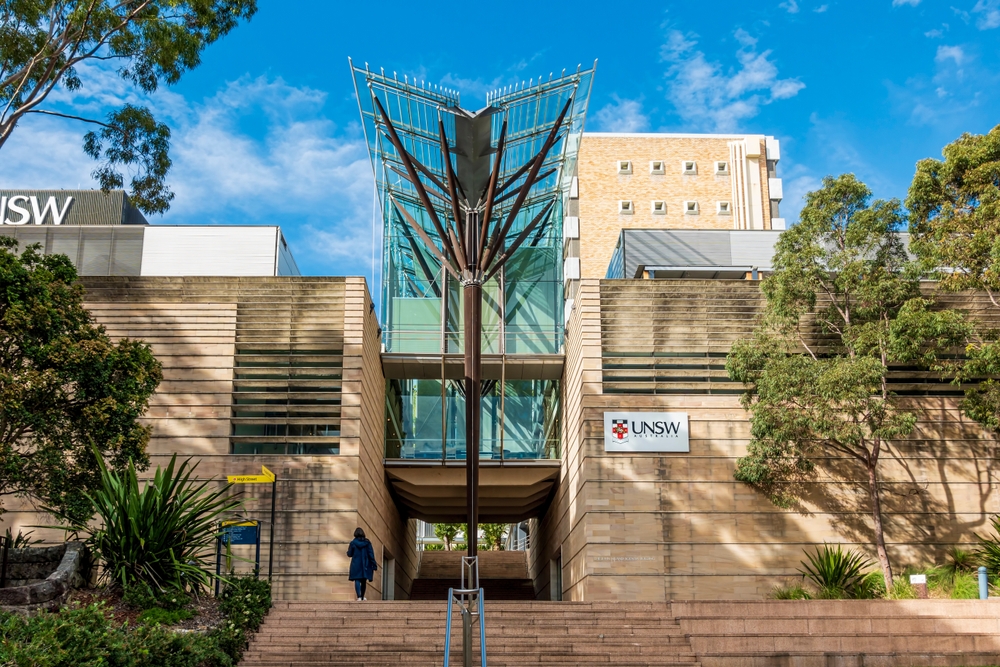
Next-generation solar modules are about to face the full force of the Australian climate at UNSW Sydney, in a bid to find out whether promising prototypes can become dependable power technology.
On a 25-by-25-metre patch of land at the university’s Water Research Laboratory in Manly Vale, up to 160 perovskite and perovskite-silicon tandem modules will be mounted outdoors.
They will endure changing temperatures, humidity, intense ultraviolet light, rain, salty air and storms, conditions that laboratory experiments cannot fully replicate.
The work is part of an $18 million, five-year project led by UNSW’s Dr Jessica Yajie Jiang, supported by $5.6 million from the Australian Renewable Energy Agency (ARENA).
Some modules may fall below a key performance threshold within months, but Dr Jiang says that is what makes the testing valuable.
“Each module has its own personality,” said Dr Jiang.
Almost every solar panel on Australian rooftops is made from silicon, a material that has helped turn solar from an expensive experiment into one of the world’s cheapest sources of electricity.
UNSW Professor Martin Green and his team spent more than four decades advancing silicon cell efficiency, and many researchers he trained now lead solar companies and manufacturing programs worldwide.
However, silicon is nearing its physical ceiling.
Dr Jiang, who completed her PhD under Prof. Green, said the theoretical efficiency limit is 29.4 per cent and the record already exceeds 28 per cent.
Perovskites, a family of crystalline materials, can be tuned to capture high-energy light that silicon converts less efficiently.
Stacking the two in a tandem cell divides the work between them and generates more electricity from the same area.
The catch is durability.
Silicon is very stable in the field, Dr Jiang said, whereas perovskite can degrade under sunlight, humidity and other environmental conditions.
Silicon panel makers commonly guarantee at least 80 per cent of original output after 25 years, a promise yet to be verified for tandem products.
Most published research on perovskite stability examines devices about one centimetre square, while commercial modules can measure as large as 1.2 metres by 2.4 metres, where uniformity and cost become critical.
As start-ups and established manufacturers prepare larger modules for deployment, independent verification is lacking.
“What is missing is that independent, third-party evidence,” said Dr Jiang.
The Manly Vale site will host single-junction perovskite modules and several forms of tandem technology, including modules that integrate perovskite directly onto silicon and those that physically stack separate devices.
Researchers will continuously monitor each module’s output, treating a drop below 80 per cent of initial efficiency as significant degradation, and will keep tracking them for as long as they last.
The team will then reproduce the relevant stresses indoors under controlled, accelerated conditions and use microscopic and nanoscale analysis to identify degradation mechanisms.
Results will go back to manufacturers, who can adjust materials, design or processes and send an updated version to UNSW for further testing.
Securing commercial modules from start-ups, which hold valuable intellectual property, is itself a significant achievement.
Dr Jiang said UNSW’s international reputation in photovoltaics, longstanding relationships with former students and record of protecting sensitive information have built years of trust.
Confidentiality agreements will protect intellectual property, results can be anonymised, and manufacturers whose modules perform poorly will not be publicly identified.
The project began this year and will run until 2031.


