



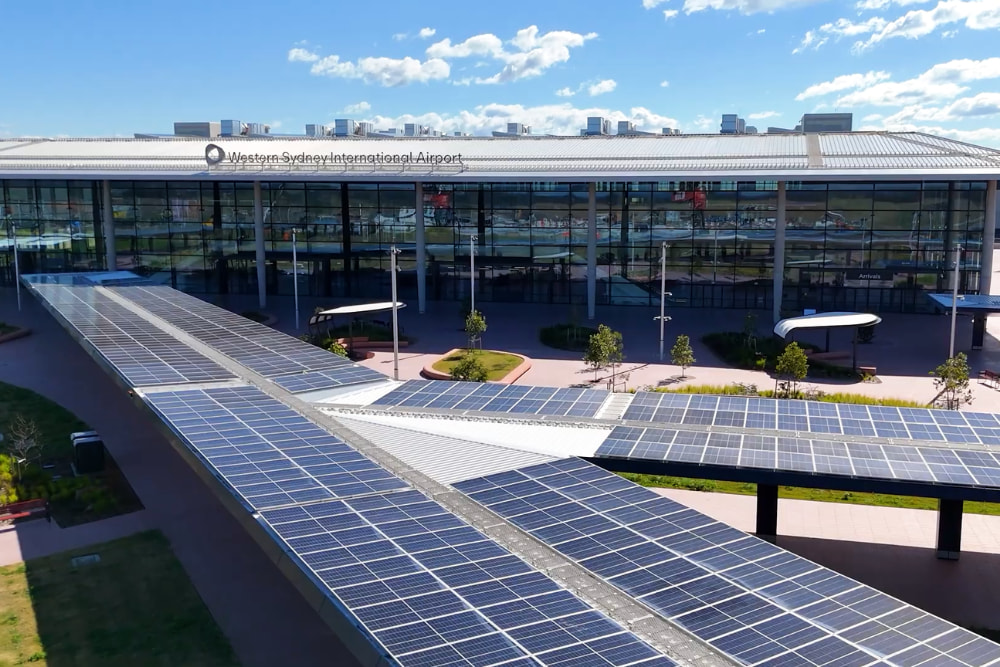
Western Sydney International Airport is preparing to open in late 2026 with its first major clean energy project now complete — a large‑scale rooftop solar installation spanning the main terminal, both piers and the covered car park walkways.
The rooftop installation spans the main terminal roof, both piers and the covered car park walkways.
It is built around 8,824 Trinasolar Vertex S+ 510W (NEG18R.28) modules, which together deliver 4.5MWp of total installed capacity.
Of that total, 3MW sits on covered walkway canopies, accounting for 60 per cent of the project’s capacity, with the remainder on the terminal and pier roofs.
The system was designed from the ground up for the airport rather than retrofitted, allowing solar to be planned into the roof and canopy structures from the outset.
The approach shows how renewable energy can be integrated into complex, large-scale infrastructure projects.
Smart Commercial Energy, the engineering, procurement and construction (EPC) contractor, delivered the project.
The job marks another milestone in a partnership between the two companies that spans more than a decade, combining Trinasolar’s globally proven solar technology with Smart Commercial Energy’s local engineering and project delivery expertise.
Delivery involved close coordination across several parties.
Smart Commercial Energy worked alongside electrical contractor Heyday5 and builder Multiplex to complete the install across the terminal, piers and car park areas.
Aligning panels, cabling and supporting structures with the wider terminal build was central to the work.
The airport setting added a further layer of complexity, with detailed glare studies required to protect pilots and air traffic control from reflection.
Ben Adamson, Head of Projects and Performance at Smart Commercial Energy, led the delivery team.
He described the scale and difficulty of the job in clear terms.
“This is one of the biggest solar installations on an airport in Australia, and a genuinely complex project,” he said.
Adamson said the team and its partners completed the work on time and on budget.
Once operating, the system is expected to generate more than 800 MWh of clean, renewable energy each year.
That output is estimated to avoid 3,712 tonnes of CO2 emissions annually, giving the new airport a low-carbon foundation before its first flights.
Huon Hoogesteger, Managing Director of Smart Commercial Energy, summed up the project’s broader message.
“Renewable energy and world-class infrastructure aren’t a trade-off, they’re part of the same project,” said Hoogesteger.


