



La Trobe University’s Melbourne (Bundoora) campus has been recertified 6 Stars under the Green Star Communities rating tool by the Green Building Council of Australia (GBCA).
The achievement, which follows an initial 6 Star rating in 2017, demonstrates world leadership in addressing a significant number of environmental and social issues while contributing to the community.
Acting Vice-Chancellor Professor Susan Dodds said the important recertification reflects the University’s commitment to both environmental sustainability and community-building in projects across the Melbourne campus.
“The development and implementation of green technologies, sustainable construction methods and engagement with community ensured La Trobe once again achieved this important certification,” Professor Dodds said.
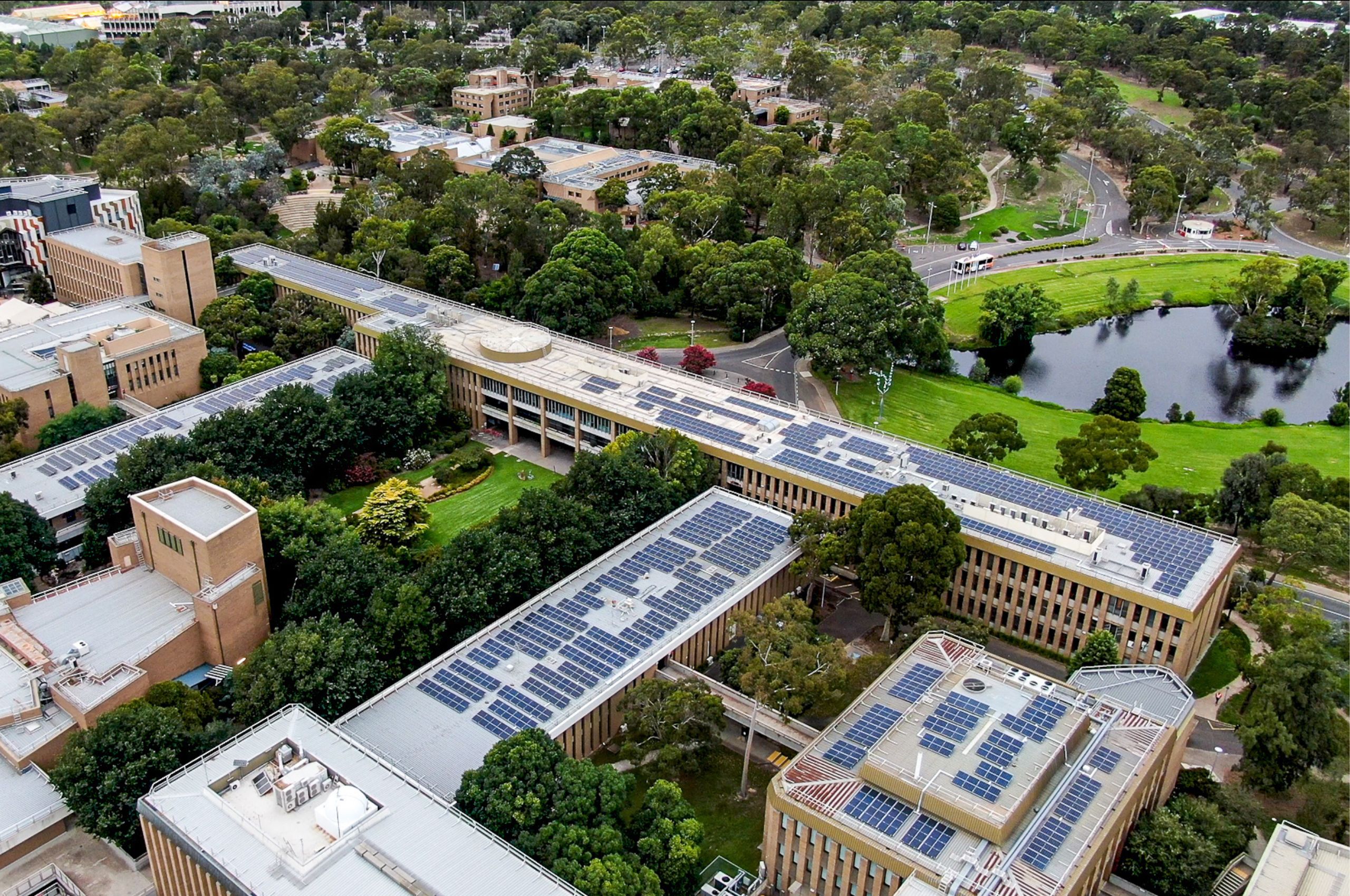
“7500 solar panels, electric vehicle charging stations and use of environmentally friendly building materials are just some of the initiatives that are contributing to the University saving hundreds of thousands of kilograms of greenhouse gases each year while powering La Trobe’s Melbourne campus in Bundoora.
“These initiatives all underpin a healthier, more resilient and community-orientated experience for our staff, students and communities,” Professor Dodds said.
La Trobe’s Melbourne campus was first awarded a 6 Star Green Star Communities rating in 2017. Certification is then reassessed every five years.
The GBCA assessed planning, design and construction projects on the Melbourne campus over the five-year certification period. The GBCA’s comprehensive analysis gauges environmental performance and overall sustainability. The recertification highlights La Trobe University’s commitment to sustainability and provides a framework for its evolving Melbourne campus.
Ongoing development of a sustainable environment at the Melbourne campus is also a key feature of the La Trobe University City of the Future transformation project that is currently being implemented at the campus.
Sustainability commitments that were instrumental to the recertification also apply to the University’s regional campuses, including its commitment to sustainable waste and water management, sustainable buildings, net zero, and indigenous landscapes.
La Trobe has an ambitious plan to be Net Zero by 2029, with all four of its regional campuses having already achieved that goal.
Key factors that contributed to this include:
- Installation of over 7,500 solar panels on more than 25 buildings – generating enough energy to supply over 50 per cent of the daytime power for the campus during peak periods.
- Commitment to sustainable building design and construction on all newly constructed buildings, as evident with the student accommodation project, which made use of Cross Laminated Timber over concrete, producing 76 per cent fewer greenhouse gas emissions. This is equivalent to taking 1,600 cars off the road.
- Installation of Electric Vehicle Chargers on campus and switching the entire passenger fleet of vehicles to electric throughout 2023. This will eliminate 200,000 kilograms of CO2 each year.
- Onsite composting unit that diverts organic waste from landfill and helps reduce greenhouse gas emissions by up to 90 per cent.
- Climate Adaptation Plan and Community Resilience Plan.
- La Trobe Energy Analytics Platform (LEAP), an innovative technology combining data analytics, artificial intelligence and machine learning to create a smart building platform which will allow the building to think for itself and reduce its energy consumption.
- The enhancement of the Nangak Tamboree eco corridor through improving biodiversity, access to nature, improving water quality and management, offering education opportunities, and respecting cultural heritage and practices.
Recognition for mitigating the heat island effect through extensive tree canopy and permeable open space.