



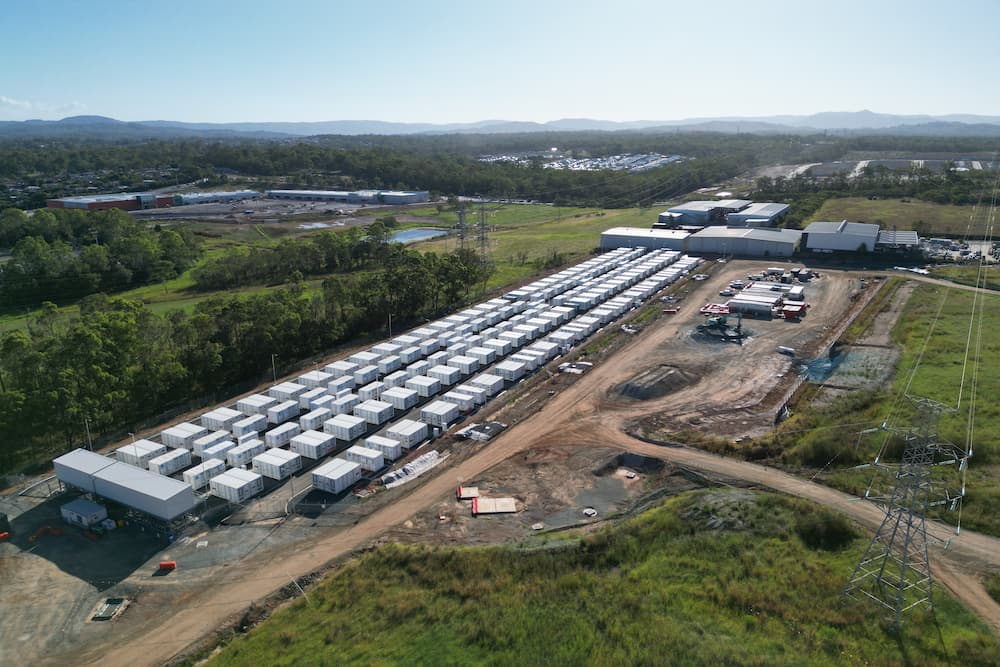
GE Vernova has been selected by investment firm Quinbrook Infrastructure Partners to supply power conversion, control, and integration technologies for the third stage of the Supernode battery energy storage system (BESS) in Queensland.
The contract expands GE Vernova’s technology deployment across all three phases of what stands as one of Australia’s largest battery storage developments.
Located adjacent to key electricity infrastructure in Queensland, the Supernode facility acts as a buffer for the state’s grid by storing surplus renewable power during peak production and releasing it when demand spikes.
Stage 3 will add 260 megawatts (MW) and 1,216 megawatt-hours (MWh) of four-hour battery storage to the precinct. Once fully completed, the unified Supernode campus will deliver a massive 780 MW and 3,075 MWh of capacity on a single site.
Stage 3 has achieved Generator Performance Standards (GPS) acceptance, a major regulatory milestone establishing its technical compliance for connection to Australia’s National Electricity Market (NEM).
The phase also marks GE Vernova’s first grid-forming battery project in the country, allowing the facility to actively provide frequency support and system strength traditionally supplied by fossil-fuel generators.
“Battery storage is becoming part of the operating foundation of modern electricity systems,” said Ed Torres, Business Leader of Power Conversion & Storage at GE Vernova.
“This important grid-connection milestone demonstrates the strength of our technology and our ability to support complex projects in Australia’s demanding grid-connection environment.”
Quinbrook Senior Director James Allan highlighted the project’s position at the core of Queensland’s power transmission grid.
“From the outset, Supernode was designed as more than just a battery storage project. Its unique location at the heart of Queensland’s transmission network makes it ideally placed to support the state’s transitioning power system well into the future,” Allan said.
He noted the Supernode site retains potential for an additional 520 MW expansion, which could accommodate further battery storage, hyperscale data centres, or a combination of both.
Stages 1 and 2 of the Supernode development are already fully operational.