The global pipeline for green hydrogen projects is growing fast, with a current target of 206 gigawatts (GW) in installed electrolyser capacity by 2040. However, a Rystad Energy analysis reveals that the locations of the planned projects are overwhelmingly in areas where water is in short supply. This means that an additional desalination market needs to be created to produce most of the 620 million cubic meters of water that these projects will need.
Research and development is underway to add and improve the built-in desalination capability of hydrogen projects, but many desalination installations will need to be external – and for the hydrogen to be “green”, they must be fed by additional clean, renewable power.
The current pipeline of projects aims to produce about 30 million tonnes of hydrogen per year by 2040, with an annual requirement of 620 million cubic meters of purified water.
More than 70 per cent of these hydrogen electrolyser projects will be located in water-stressed areas such as Spain and Chile, and as a result nearly 85 per cent of the hydrogen capacity lined up for 2040 may need to source water supply via desalination.
To ensure the hydrogen produced is green, additional renewable energy capacity will be required for the desalination process, as currently only 1 per cent of global desalination projects are powered by renewables. Most operating desalination plants use thermal energy or power from the local grid.
Minh Khoi Le, Renewable Energy Analyst at Rystad Energy, said: “Using water to produce clean hydrogen will be a key factor for the energy transition, but most of the world’s planned green hydrogen projects are to be located in water-stressed regions. This creates a need for growth in the desalination market, and for more renewable energy to power it, adding more costs for developers – but also opportunities for suppliers.”
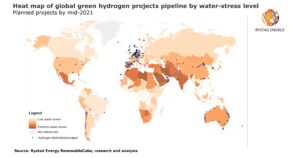
The top five regions by planned green hydrogen capacity are currently Australia, Western Europe, Central Asia, West Africa and the Middle East. Except for Western Europe, all these regions have medium or higher water-stress levels, according to peer-reviewed information from the World Resource Institute, which means the demand for freshwater is starting to threaten supply capacity.
There are also several hydrogen electrolyser projects in countries with high levels of water stress outside of these five regions – Spain and Chile, for instance, are among the countries with the highest water stress and currently have a combined 42 projects planned, with more expected to come.
Rystad Energy’s analysis finds that 14 green electrolyser projects are planned in countries with extremely high water-stress levels, 53 projects are in countries with high water stress, and 162 projects are located in regions with medium to high water stress.
The company notes that hydrogen electrolyser projects in the high to extremely high water-stressed countries will almost certainly require desalination for their water supply – potentially implying a demand of 125.7 million cubic meters of water annually for desalination by 2040.
Some notable green hydrogen projects in Oman (Alwusta) and Saudi Arabia (Neom) as well as numerous projects in Spain will be in this category.
Rystad forecasts that demand for desalination could grow fivefold to 526 million cubic meters by 2040 if all the hydrogen projects within regions with water stress levels above medium are realised.
This will include heavy hitters in the green hydrogen pipeline such as projects in Australia (e.g., TotalEnergies’ HyEnergy 5 GW electrolyzer) and Germany (e.g. Aquaventus at 10 GW by 2035).
The United Nations (UN) expects freshwater demand to increase globally by 60 per cent by 2025 − for agriculture alone. Therefore, regions with water stress levels above medium will most likely need to develop this additional desalination capacity to support green hydrogen facilities.
While there are only a few projects in regions of low water stress, many of these are located near shore and/or taking offshore wind as feedstock (for instance in Western Europe and Brazil). If all these projects add seawater desalination, total desalinated water demand for green hydrogen would hit 620 million cubic meters by 2040.
There is currently only a handful of commercial-scale desalination facilities that use renewable energy. Two of the biggest such desalination projects are in Australia – both using wind power: the Kwinana project is powered by the 80-megawatt (MW) Emu Downs wind farm, while the Kurnell development is supplied by the 140 MW Bungendore wind farm.
Solar PV also features in some desalination projects but on a smaller scale, including at the Al Khafji and Yanbu 4 seawater reverse osmosis plants in Saudi Arabia. Some commercial electrolyser systems have moved to include reverse osmosis desalination units.