The City of Sydney has announced that it will target net-zero carbon emissions by 2035 – five years earlier than previously planned – in a move to help avert catastrophic climate change.
Lord Mayor of Sydney, Clover Moore, said the revised target, a feature of the proposed new Environmental Strategy 2021-2025, underscores the City’s commitment to action on climate change.
“We’re in the middle of a climate emergency, yet the Federal Government continues to ignore the community, expert advice and international pressure,” the Lord Mayor said.
“Australia’s emissions have been going up since 2014, and in the face of the Government’s shameful inaction we are stepping up to reduce our emissions steeper and sooner.
“The City of Sydney was the first local government in Australia to become carbon neutral in 2007 and our operations are now powered by 100 per cent renewable electricity.”
“This year we’ll meet our 2008 goal to reduce emissions by 70 per cent by 2030 – nine years earlier than initially targeted. We’re leading by example to tackle the climate crisis and reaching net-zero as soon as possible is the next step.”
The target is in line with research confirming Australia and the rest of the world need to reach net-zero emissions by 2035 to avoid the catastrophic consequences of more than 1.5 degrees of global heating.
“Overwhelming climate research tells us we cannot afford to take our time reducing carbon emissions in Australia – emissions need to plummet now,” the Lord Mayor said.
“While the City of Sydney cannot tackle the climate crisis alone, we can lead and encourage others to do the same within their communities.”
“Greening the grid, diverting waste from landfill and increasing green building standards will all play a part in how we meet the challenges of the climate crisis and create a city that is net-zero in less than 15 years,” she said.
“Achieving net-zero means the greenhouse gas (GHG) emissions produced in an area must not exceed the GHG emissions taken out of the atmosphere through offset programs. The only realistic way to do this is by slashing the amount of emissions generated in the local area.”
The City will attempt to slash local area emissions by targeted programs to manage waste, energy and fuel.
Greening the grid
Energy consumption produces 73 per cent of the local area’s GHG emissions. By encouraging businesses, residents and other organisations to use renewable energy sources and switch to Green Power, the City plans to significantly reduce this number.
Tackling transport emissions
The transport sector is the second biggest contributor to emissions after energy. In 2018–2019 it was responsible for 16 per cent of the local area’s carbon emissions, either through petrol from vehicles or the electricity used to power public transport.
The City aims to lower these emissions by continuing to encourage a shift away from private vehicles and towards public transport, walking and cycling, as well as supporting businesses shift to electric vehicles.
While the City does not control much of the transport sector, it will help to reduce emissions from transport by partnering with the Australian and NSW governments, to make it easier for them to achieve their emissions targets and to support off-street charging stations for electric vehicles.
War on waste
From tackling single-use plastics to recycling food scraps, reducing waste and better waste management is another key component of lowering the area’s emissions.
The Environmental Strategy 2021-2025 targets waste reduction across the residential sector, aiming to divert 90 per cent from landfill by 2030.
By far the greatest contributor to residential waste is food, accounting for more than a third of space in our bins. The City is running a food scraps recycling trial, with around 11,000 households currently able to access the scheme – with another 10,000 households expected to have access by September 2021.
Recycling food waste saves landfill space and reduces GHG emissions. It can be used to create green electricity and fertiliser. Every tonne of food waste the City diverts, and processes saves 1.69 tonnes of carbon emissions.
Waste and waste management currently account for around 9 per cent of the City’s emissions.
Energy-efficient buildings, pollution and adaptation
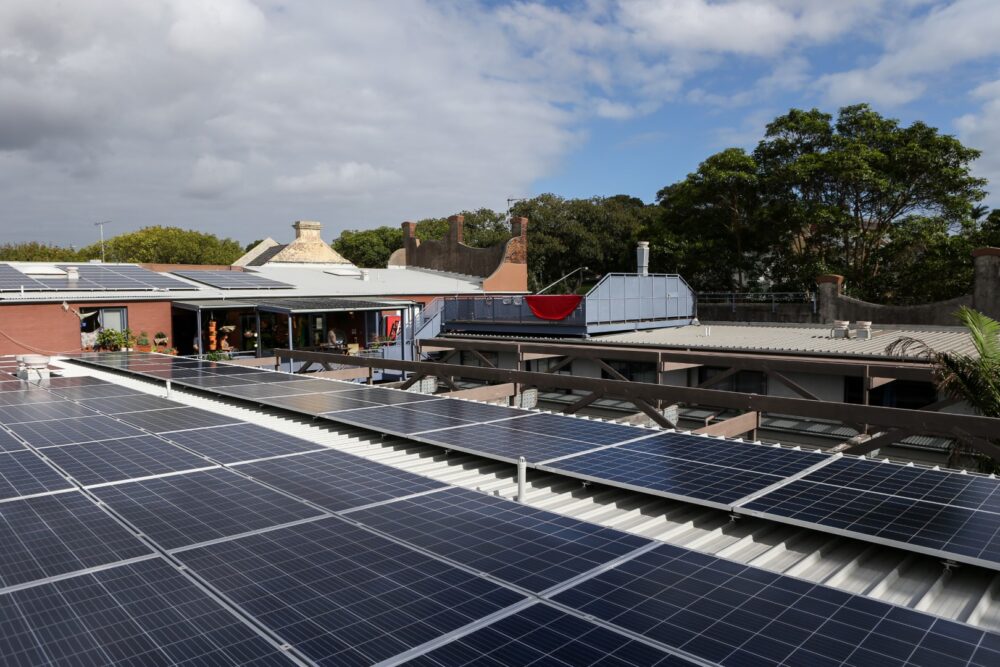
The City will support the development of energy-efficient buildings.
The Environmental Strategy 2021–2025 addresses the regeneration of polluted waterways, air and land as well as planning for how the area can adapt to the climate crisis.
Improving the City’s own operations
The City will take action to further improve the environmental performance of its own operations.
From July 2020, the City began using 100 per cent renewable electricity, and it is expecting emissions to drop to more than 76 per cent below 2006 levels by the end of June 2021.
The City’s sustainability achievements to date include:
- Contributed to emissions reduction across the city local area of 22 per cent from 2006 to 2019;
- Made e-waste recycling collections available to all residents;
- Established a precinct recycled water scheme at Green Square;
- Helped 172 apartments reduce emissions by 20,000 tonnes; and
- Set up water reuse schemes in 20 parks, providing 80,000 litres of recycled water a day during summer.
The strategy will be presented to Council for approval this month. Following approval, the draft strategy will go on public exhibition from 19 May to 16 June.
A copy of the draft Environmental Strategy 2021-2025 can be found here.