




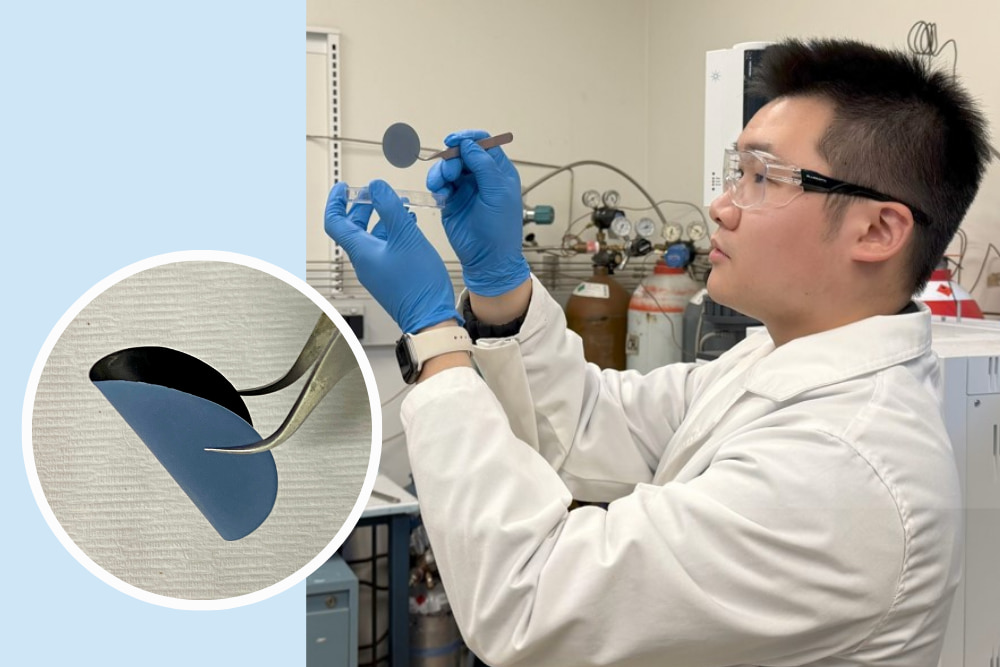
Monash University researchers have created a graphene-based membrane capable of conducting protons at high temperatures without water, potentially unlocking a new era for clean hydrogen energy.
Engineers have developed a new ultra-thin membrane that allows fuel cells to operate more efficiently at high temperatures by enabling proton transport without water, overcoming a key limitation in clean energy technologies.
The breakthrough, reported in Science Advances, could expand the use of fuel cells in transport, heavy industry, and future clean energy systems.
Fuel cells convert chemical energy directly into electricity, producing water and heat as the main by-products.
They are already used in hydrogen-powered vehicles, backup power systems for hospitals and data centres, and space missions where lightweight, reliable energy is essential.
However, most current systems rely on water-dependent membranes that limit performance at higher temperatures, where efficiency could otherwise improve, and system design could be simplified.
The breakthrough is based on atomically thin nanosheets combined with nanoconfined phosphoric acid.
Conventional nanosheet assemblies often suffer from poor proton transport between layers, limiting their practical use in electrochemical devices.
The specially engineered membrane, made from graphene and boron nitride, enabled ultra-fast proton transport at 250 degrees Celsius and delivered exceptionally high power output in hydrogen fuel cells.
It also performed well when using concentrated methanol as a fuel, demonstrating stability and efficiency under harsh, high-temperature conditions.
Corresponding author Professor Huanting Wang, from the Monash Department of Chemical and Biological Engineering, said the work directly addresses a long-standing barrier in the field.
“By integrating proton-conducting nanosheets with nanoconfined phosphoric acid, we have created a membrane that maintains fast proton transport without relying on water,” said Professor Wang.
“This enables fuel cells to operate efficiently at much higher temperatures than is currently possible.”
The paper’s first author, Postdoctoral Research Fellow Dr Kaiqiang He, also of the Department of Chemical and Biological Engineering, said the key advance lies in combining multiple proton transport mechanisms within a single membrane architecture.
“The nanosheets provide direct proton transport pathways, while the confined phosphoric acid enables rapid proton hopping,” said He.
“Together, these mechanisms deliver both high conductivity and stability under dry, high-temperature conditions.”
This dual-mechanism approach distinguishes the new membrane from prior attempts to develop water-free proton conductors, which have typically struggled to maintain performance under the demanding conditions required for industrial-scale use.
Beyond fuel cells, the same design approach could support a range of electrochemical technologies, including water splitting, carbon dioxide reduction, and ammonia synthesis.
More broadly, the research offers a platform for designing next-generation proton-conducting materials by integrating two-dimensional nanosheets with nanoconfined proton carriers.
The findings come at a critical moment for the hydrogen sector, which has faced persistent technical and economic hurdles on the path to widespread commercial deployment.
Advances in membrane technology that reduce reliance on humidification systems and allow higher operating temperatures could meaningfully lower the cost and complexity of fuel cell systems across a range of applications.


